
The Problem:
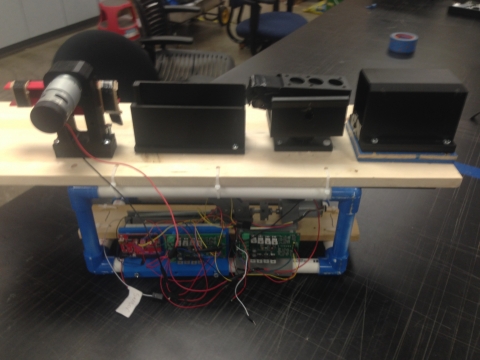
The operates in 3 phases: removal of battery, rotation of UAS, and loading of a new battery. First the removal process will be discussed. The human pilot will first land in a battery chassis. A IR break beam sensor will be triggered. The chassis will tightly grip the battery container located below the UAS. Next a motor will begin to rotate, causing a metal rod to collide with the depleted battery. The battery will then fall into a containment system. The motor will then rotate in the opposite direction, resulting in the metal rod to return to its starting position. With the rod in its initial position, the removal process is complete.
Next is the rotation of the UAS. As stated before the UAS will land into a battery chassis. This chassis is directly connected to a motor. After the removal process is complete, the motor below the chassis will rotate a full 180 degrees. With the UAS facing the opposite direction, the loading of a new battery can begin.
Finally, the loading process can begin. The loading process begin with a new battery being raised from a battery receiver. After the battery has been raised, the back motor engages again pushing the new battery into the battery container. The metal rod returns to its original position. With a new battery in the UAS, the chassis loosens its grip. The human pilot then can continue with mission.
Manufacturing:
The team had to requirements for the construction of the Battery Replacement System: low cost and easily replaceable parts.To keep the overall price of the system down, we used easily avalible components like PVC piping, DC Motors, and an Arduino. Any custom parts that were needed, were constructed using 3D printing technology. Every part on the Battery Replacement System can be qucikly replaced if any part begins to malfunction or is damaged during use. The parts can be replaced by purchasing new parts or by printing a part using a 3D printer.
Current Progress and Future Steps:
Currently the project is on its Second Prototype, which allows for the replacement of sUAS batteries in a laboratory enviroment. The team is currently work on getting the station ready for field use by integrating a portable power source and optimizing current parts for field use.


